

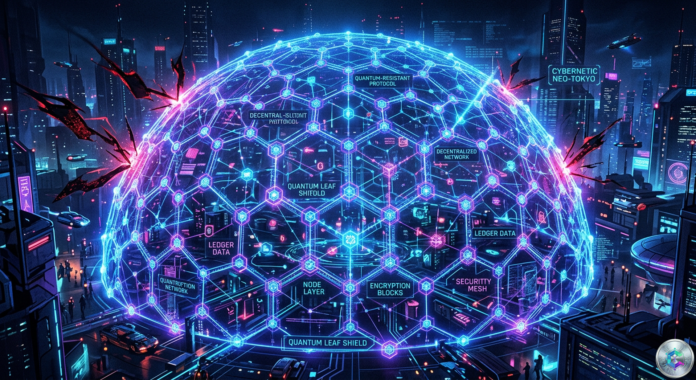
Naoris Protocol Launches Its Mainnet: The First Post-Quantum Blockchain Responds to the Growing Threat to Classical Cryptography
On April 1, 2026, Naoris Protocol officially launched its mainnet, marking the advent of the first layer-1 blockchain natively integrating post-quantum cryptography standards. A direct response to accelerating quantum research threatening the very foundations of blockchain security.

The quantum threat to cryptocurrencies is no longer a distant hypothesis. It is approaching, and the industry is starting to take notice. On April 1, 2026, Naoris Protocol launched its mainnet — a layer-1 blockchain designed from its inception to integrate NIST-standardized post-quantum cryptography. A first in the industry that could redefine Web3 security standards.
The Quantum Threat Is Becoming Concrete
For years, quantum computing was presented as a distant threat, a question of « if » rather than « when. » But the research published in early 2026 changed the game.
Google published a study in March 2026 revealing that the qubit requirements for breaking the cryptography protecting Bitcoin and Ethereum would be far lower than previous estimates. According to this research, fewer than 500,000 physical qubits would suffice — a twentyfold reduction compared to previous projections.
More alarmingly, researchers at the California Institute of Technology, working with Oratomic, estimated that with recent improvements in error correction (which reduce the number of qubits needed to stabilize computations), a viable quantum computer could emerge as early as 2030, with requirements estimated between 10,000 and 20,000 stable qubits — where previous projections had relied on millions.
Justin Drake, a researcher at the Ethereum Foundation, goes further: he estimates at least a 10% probability that a quantum computer could recover a private key by 2032.
These figures have woken up the entire blockchain ecosystem.
Why Classical Cryptography Is in Danger
Current blockchains — Bitcoin, Ethereum, Solana, and virtually all others — rely on cryptographic algorithms vulnerable to quantum attacks. The ECDSA (Elliptic Curve Digital Signature Algorithm) used by Bitcoin and Ethereum, as well as Solana’s Ed25519, are both protected by mathematical problems (the factorization of large prime numbers and the discrete logarithm over elliptic curves) that a sufficiently powerful quantum computer could solve in polynomial time.
The problem is particularly acute for blockchain security models: once a private key is exposed, any transaction signed with that key becomes vulnerable. In the quantum world, an attacker could derive a private key from a public key — and thus sign transactions impersonating any holder.
But the most concerning dimension is « harvest now, decrypt later » — the threat model where encrypted data is collected today to be decrypted tomorrow, once quantum capability becomes available. This means that transactions recorded today, even perfectly secure right now, could be compromised in a few years.
Naoris Protocol: An Architecture Born Post-Quantum
Faced with this assessment, Naoris Protocol adopted a radically different approach from most blockchain projects: instead of attempting to retroactively fix architectures designed without quantum threats in mind, the protocol was designed from its genesis block to integrate post-quantum cryptography.
The protocol uses algorithms standardized by NIST — the National Institute of Standards and Technology in the United States — including Dilithium-5, a lattice-based cryptographic algorithm that will resist, according to current knowledge, quantum attacks.
The architecture relies on what Naoris calls the dPoSec — distributed Proof of Security — a consensus mechanism that verifies the security of each transaction across a network of validator nodes. This is not a simple addition of post-quantum cryptography to an existing system: it is a redesign of the security layer at the consensus protocol level.
« Mainnet represents the transition from proof-of-concept to production infrastructure. The network has already validated over 100 million transactions using post-quantum cryptography. This is not a roadmap promise; it is measured, operational capacity, » said Nathaniel Szerezla, Chief Growth Officer of Naoris Protocol.
Impressive Testnet Results
Before the mainnet launch, Naoris Protocol had already demonstrated the viability of its approach at scale. The testnet phase, which concluded in November 2025, mobilized hundreds of thousands of participants worldwide.
During this period, the network:
- Processed over 106 million post-quantum transactions
- Detected and neutralized over 603 million security threats
- Created over 3.3 million wallets
- Activated over one million security nodes globally
These figures demonstrate that decentralized post-quantum security is not just a theoretical concept: it works at scale, under real-world usage conditions and under adversarial conditions.
The NAORIS Token and the Economic Model
At the heart of the Naoris ecosystem, the NAORIS token plays a central role. It powers transaction validation, the enforcement of security rules, and the trust mechanism across the network — forming the economic layer of this emerging post-quantum infrastructure.
The token has experienced significant volatility in recent months. After simultaneous listing on Binance Futures (with perpetual contracts) and the regulated Hong Kong platform Hashkey, Naoris’ market capitalization approximately doubled in a single trading session, reflecting speculative interest in the quantum security narrative.
According to CoinMarketCap data, current token liquidity remains constrained at approximately $0.07, with expansion to broader mainnet participation considered critical for unlocking demand and network effects.
Naoris was also cited in a research submission to the U.S. SEC in September 2025, presented as the reference model for post-quantum financial infrastructure within the Post-Quantum Financial Infrastructure Framework (PQFIF) — significant regulatory recognition that enhances the project’s credibility.
A Accelerating Regulatory Context
Naoris Protocol’s mainnet launch comes within a growing global regulatory movement around post-quantum cryptography.
In March 2026, the U.S. National Cybersecurity Strategy further accelerated the adoption of post-quantum cryptography across federal systems and emerging technologies. Internationally, the European Union has adopted a coordinated timeline requiring Member States to begin national PQC strategies by 2026, mandating quantum-resistant encryption for critical infrastructure by 2030, and targeting full PQC transition by 2035.
The G7, through its Cyber Expert Group, published a financial sector roadmap in January 2026, setting the objective of migrating critical systems by 2030-2032, with full transition by 2035.
Beyond Naoris, the entire blockchain ecosystem is beginning to move. On March 24, 2026, the Ethereum Foundation launched a « Post-Quantum Ethereum » resource hub detailing plans to upgrade the network’s cryptography, with protocol-level changes targeted for 2029 — while acknowledging the multi-year complexity of such a transition.
In January 2026, developers in the Solana ecosystem introduced a quantum-resistant vault using hash-based signatures to generate new keys for each transaction, reducing public key exposure.
The Quest for the Sub-Zero Layer
Naoris positions its approach as operating at the « Sub-Zero Layer » — a layer located below the traditional L0 to L3 — where trust is continuously verified and enforced through its dPoSec consensus model.
This approach extends beyond blockchains alone: the protocol aims to secure cross-chain transactions, DeFi protocols, validators, cross-chain bridges, centralized exchanges, enterprise networks, and even IoT devices — proposing what they describe as a new paradigm where security becomes foundational infrastructure.
« Our mainnet launch represents the beginning of a new internet architecture, » said David Carvalho, CEO and Founder of Naoris Protocol. « After a breakout year that validated our vision at the highest regulatory, technological, and global levels, Naoris enters 2026 positioned to deliver what the quantum era demands: security as critical infrastructure, built for a world where trust must be decentralized, continuous, and quantum-safe. »
The Challenges of Transition
Despite the stated urgency, the road to a post-quantum blockchain industry is fraught with obstacles. Migrating existing systems to post-quantum algorithms is a massive, slow, expensive, and complex software project.
According to cybersecurity experts, the main challenges are:
- Cryptographic inventory: identifying every instance of vulnerable algorithms in distributed systems
- Crypto-agility: the ability to switch to new algorithms without re-architecting the entire infrastructure
- Digital signatures: far more difficult to migrate than encryption, as they concern transaction history
- Existing PKIs: long-duration certificates become problematic when underlying keys could be compromised
As the EU PQC migration report notes, the full transition could take a decade, and the majority of organizations depend on suppliers who will not migrate synchronously.
Conclusion: A Blockchain Born for the World of Tomorrow
Naoris Protocol’s mainnet launch on April 1, 2026 represents far more than a simple technical milestone. It is the first concrete demonstration that a blockchain can be designed from inception for a post-quantum world, with results validated at scale.
Admittedly, the quantum threat is not imminent — the most optimistic estimates place the horizon at 2030 at the earliest. But the « harvest now, decrypt later » model reminds us that data collected today will be vulnerable tomorrow. In this context, every month of delay in transition represents an accumulation of risk.
For now, Naoris Protocol remains in a restricted access phase, with invited validators and strategic partners forming the initial trust layer. Expansion to broader access will proceed gradually.
What is certain is that the question of post-quantum security is no longer a theoretical debate. It is on the roadmap of Google (2029), the European Union (2030-2035), the Ethereum Foundation (2029), and now a blockchain protocol in production. The post-quantum era is being prepared — and Naoris Protocol just opened its door.
Sources:
- The Quantum Insider / Naoris Protocol PR, April 1, 2026
- Cointelegraph / TradingView, April 2026
- Google Security Blog, March 2026
- Ethereum Foundation — Post-Quantum Ethereum Resource Hub, March 2026
- NIST — Post-Quantum Cryptography Standards, 2024
- European Commission — Coordinated PQC Roadmap, 2026
- CoinMarketCap — Naoris Protocol Price Data, April 2026

