

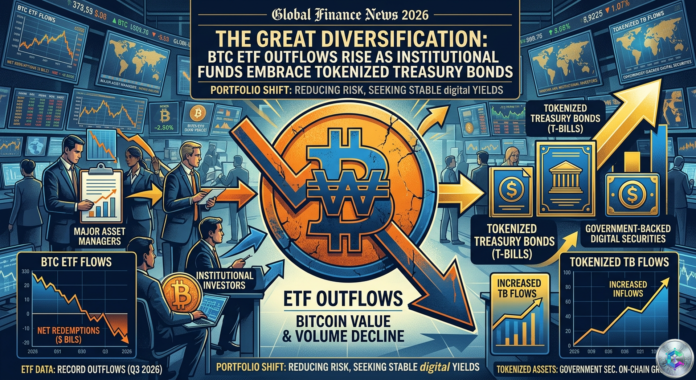
A Structural Shift in Institutional Crypto Markets
March 2026 will be remembered as the month when institutional investors executed a major strategic pivot in their approach to cryptocurrencies. After months of massive inflows into spot Bitcoin ETFs, market data now reveals a paradigm shift: outflows dominate, and billions of dollars are redirecting toward tokenized treasury products.
On Thursday, March 27, 2026, the eleven U.S.-listed spot Bitcoin ETFs recorded combined net outflows of $171.12 million, according to data from SoSoValue. This marked the largest single-day outflow in just over three weeks. This massive withdrawal is not an isolated incident—it fits into an underlying trend that accelerated throughout the month.
The March 2026 Paradox: Price Strength Despite Outflows
The irony of the current market lies in this troubling disconnect: despite record ETF outflows, Bitcoin’s price has maintained remarkably high support levels. The leading cryptocurrency continues to trade above $68,000 in late March—a resistance level that defies bearish expectations.
This divergence is explained by several converging factors. First, ETF outflows represent a marginal portion of total daily Bitcoin trading volume. Second, long-term holders—often called « whales » in crypto jargon—maintain their positions with remarkable firmness. Third, Bitcoin’s narrative as a geopolitical safe-haven asset is gaining credibility among traditional investors.
The Great Rotation: From Crypto ETFs to Tokenized Treasuries
The most significant phenomenon of this March 2026 isn’t so much the Bitcoin ETF outflows as the destination of these redirected funds. According to data compiled by Fensory, no less than $12.8 billion flowed into tokenized treasury products during the same period.
This massive rotation demonstrates a maturation of institutional behavior toward digital assets. Jennifer Walsh, Chief Investment Officer at Ontario Teachers’ Pension Plan—one of Canada’s largest pension funds with $45 billion in assets—revealed that her institution had reduced its Bitcoin ETF allocation by 40% during March while increasing its tokenized treasury positions to 2.1% of total assets.
« We’re seeing a maturation of institutional thinking around digital assets, » Walsh said in an interview with Financial News. « Tokenized products offer clearer regulatory frameworks and exposure to less volatile underlying assets than Bitcoin. »
Regulatory Framework: Growing Clarity for Tokenized Products
The U.S. Securities and Exchange Commission (SEC) published on March 5, 2026, a historic directive regarding asset-referenced tokens. This regulatory clarification provided a more robust legal framework for tokenized treasury products, in contrast to crypto ETFs which still face persistent questions about custody arrangements and market manipulation risks.
This regulatory asymmetry largely explains the rotation of flows. Institutional asset managers now prioritize products offering maximum legal clarity, even if it means sacrificing some of Bitcoin’s appreciation potential.
Bitcoin ETFs Facing Market Reality
Monday, March 26, 2026, marked another difficult day for spot Bitcoin ETFs. The Bitcoin-backed products recorded net outflows of approximately $300 to $350 million according to market estimates, making this session one of the most significant redemption events in recent weeks.
On March 20, Bitcoin ETFs had already extended a multi-day redemption trend totaling approximately $52 million in outflows. This sequence of redemptions interrupted the positive momentum recorded earlier in the month, when more than $1 billion in net inflows had supported Bitcoin’s rebound toward $68,000.
Despite these recurring outflows, trading activity in crypto ETFs remains elevated. Several March sessions ranked among the highest trading volumes since the launch of spot Bitcoin ETFs in January 2024, indicating that institutional participants maintain their engagement even during net selling periods.
ETF Flows as the Institutional Barometer
For market participants, ETF flows have become the primary indicator of institutional demand for cryptocurrencies. This metric offers real-time visibility into institutional allocations, allowing analysts to calibrate their price expectations with unprecedented precision.
Sustained inflows would signal renewed institutional conviction and support higher price levels. Conversely, continued outflows could reinforce downside pressure across digital asset markets.
Ryan Lee, chief analyst at BitBull Capital, observes: « ETF flows have become our most valuable analytical tool. They capture the essence of institutional sentiment better than any survey or sentiment indicator. »
BlackRock and Asset Management Giants: Positioned for the Transition
BlackRock, with its Bitcoin Trust ETF (IBIT) now exceeding $55 billion in assets under management and its Ethereum Trust (ETHA) at $6.5 billion, dominates the crypto ETF product market. The asset management giant captured approximately 95% of net inflows into digital asset index products in 2025.
However, even BlackRock isn’t immune to the refocusing trend toward tokenized products. The firm has launched several tokenized money market fund products in recent months, responding to institutional demand for digital asset exposure with reduced volatility.
Jay Jacobs, BlackRock’s U.S. head of equity ETFs, acknowledges this market evolution: « We’re clearly seeing institutional segmentation. Some investors are seeking pure Bitcoin exposure without staking complexities, while others prioritize products that generate regular returns via staking or stablecoin yield. »
Technical Analysis: Bitcoin Defends Key $65,000 Level
From a technical perspective, Bitcoin maintains a remarkably resilient market structure. The $65,000 level acts as a dynamic support, attracting buying during pullbacks to this zone. The 50-day and 200-day moving averages are converging, reducing the asset’s historical volatility.
On-chain indicators also reveal mixed but generally constructive signals. The burn rate of long-held coins remains moderate, indicating that long-term investors aren’t rushing to take profits despite recent price movements.
On-chain trading volume remains stable around $30 billion daily—a level that supports the thesis of an active market without seller panic. Exchanges continue to record net Bitcoin outflows to cold wallets, reducing the available supply for immediate sale.
Outlook for Q2 2026
Market professionals diverge on short-term prospects. Some anticipate prolonged consolidation in a range between $60,000 and $75,000, while others view ETF outflows as an opportunity to accumulate before a new directional move.
Macroeconomic factors remain a determining element. Federal Reserve monetary policy decisions, geopolitical developments in the Middle East, and regulatory evolutions will continue to influence flows to cryptocurrencies and tokenized products.
The Q1 2026 earnings season for major tech companies could also influence institutional allocations. If tech stocks overperform, this could reduce appetite for alternative assets like Bitcoin. Conversely, tech sector weakness would reinforce the diversification argument toward cryptocurrencies.
Conclusion: A Market Coming of Age
March 2026 marks a turning point in institutional cryptocurrency history. The period of massive and undifferentiated flows into Bitcoin ETFs is giving way to more sophisticated allocation, distinguishing between pure Bitcoin exposure and products generating returns via staking or tokenized treasuries.
This evolution isn’t necessarily bearish for Bitcoin. On the contrary, it demonstrates the growing integration of cryptocurrencies into traditional allocation models, with vehicles adapted to each risk profile. Current flows into tokenized treasuries could ultimately free up mental and budgetary resources for larger Bitcoin allocations once the consolidation phase ends.
For retail investors, this period offers opportunities to accumulate at favorable levels, benefiting from weak institutional flows to strengthen positions before the next inflow cycle. The mantra remains: the best buying opportunities occur when institutional flows are at their weakest.
Sources: CoinDesk, SoSoValue, Fensory, Financial News, HedgeCo.net

