

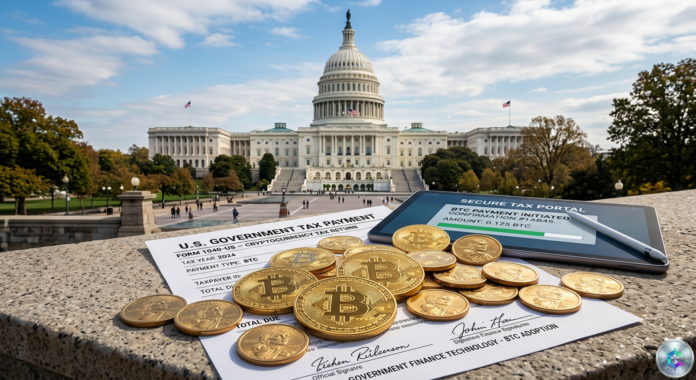
US Bill Proposes Paying Taxes in Bitcoin and Eliminating Capital Gains Tax
Two revolutionary bills could transform the relationship between cryptocurrencies and the American tax system. The « Bitcoin for America Act » and the « Digital Asset PARITY Act » represent an unprecedented step toward Bitcoin integration into the traditional economy.
The « Bitcoin for America Act »: A Historic First
A new bill filed in Congress could allow Americans to pay their taxes in Bitcoin without incurring capital gains tax. Congressman Davidson, who presented this innovative proposal, emphasized that the bill would also centralize custody of seized Bitcoin under the U.S. Treasury.
This initiative addresses a major problem identified by authorities: managing lost private keys across federal agencies. By centralizing digital asset custody, the government hopes to resolve difficulties with inaccessible BTC.
The Digital Asset PARITY Act: A Comprehensive Tax Overhaul
Meanwhile, Representatives Max Miller (R-OH) and Steven Horsford (D-NV) presented a revolutionary bill titled the « Digital Asset PARITY Act. » This text aims to fundamentally reform how digital assets are taxed in the United States.
This proposal comes against a backdrop of increasing legislative activity concerning digital assets. The bill addresses several practical problems that have hindered cryptocurrency adoption for everyday payments.
Stablecoin Exemption
One of the most significant measures concerns stablecoins. The bill proposes a capital gains tax exemption for dollar-pegged stablecoins, provided their value does not fluctuate by more than one cent from their acquisition cost.
This provision recognizes stablecoins’ primary function as a digital proxy for the dollar rather than as a speculative investment. For users, this means moving USDT or USDC for everyday purchases would no longer trigger taxable events.
Exclusion of Transaction Fees
The bill also addresses transaction costs. Fees incurred when acquiring or transferring regulated stablecoins would be excluded from the investor’s cost basis calculation. This technical change prevents these operational costs from artificially inflating the taxable gain or loss when the asset is later sold.
The De Minimis Exemption: A $200 Threshold
For small-scale transactions, the bill provides a de minimis exemption. Stablecoin transactions under $200 would not require tax payments or reporting, though an annual cap for this exemption remains undetermined.
This provision recognizes cryptocurrency use as a medium of exchange rather than as an investment vehicle. As explained by a tax attorney specializing in digital assets: « The de minimis exemption for sub-$200 transactions is a pragmatic recognition of cryptocurrency’s use as a medium of exchange. It alleviates the record-keeping nightmare for users making small, frequent payments. »
A Long Legislative Process
Despite the generated enthusiasm, the path to adoption remains long. The bill must be formally introduced to Congress, assigned to a committee—likely the House Ways and Means Committee—then undergo hearings, amendments, and votes in both Chambers before potentially reaching the President.
This preliminary draft stage represents the beginning of a potentially lengthy political and procedural process. The coming months will be dedicated to discussions with crypto industry stakeholders, tax professionals, and fellow legislators to refine the text.
Implications for Cryptocurrency Adoption
If these bills succeed, they could have a substantial impact on cryptocurrency adoption. Removing capital gains tax on stablecoins and simplifying reporting requirements make cryptocurrencies much more practical for daily use.
For businesses in the sector, these changes would mean a significant reduction in administrative burdens related to tax compliance. For individual users, this would make cryptocurrency payments as simple as traditional euro or dollar transactions.
International Context
This American evolution comes amid a global context where several countries are exploring similar approaches. In Brazil, Congress is considering a bill to gradually acquire 1 million BTC over five years under a program called RESbit. This proposal aims to expand Brazil’s strategic Bitcoin reserve, potentially making it one of the largest holders of Bitcoin globally.
Conclusion
The « Bitcoin for America Act » and « Digital Asset PARITY Act » represent a historic turning point in how governments view cryptocurrencies. By proposing to treat Bitcoin as currency for tax payments and simplifying stablecoin taxation, American legislators recognize the growing role of digital assets in the modern economy.
Although these bills are still in draft form and must undergo a long process before adoption, their introduction marks a pivotal moment in American monetary and fiscal policy evolution. The entire financial technology sector will be watching these developments closely as a bellwether for future, innovation-friendly regulation.

