

Bitcoin Emerges as Geopolitical Hedge: JPMorgan Highlights Historic Divergence from Gold
As gold ETFs see $11 billion in outflows in March, Bitcoin demonstrates its capacity to serve as a safe-haven asset amid major Middle East geopolitical conflict
March 27, 2026 — In a report published on March 26, JPMorgan Chase delivers a striking analysis: since the escalation of the Middle East conflict involving Iran, Bitcoin has exhibited safe-haven characteristics, while gold and silver — the traditional crisis havens — are experiencing massive capital outflows.
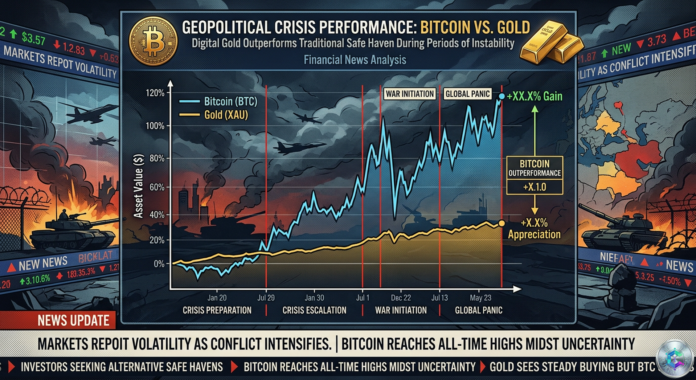
Bitcoin Outperforms Gold Since Conflict Began
Since the escalation of Middle East tensions, Bitcoin has appreciated approximately 11%, while gold fell nearly 15% over the same period. BTC was trading around $68,597 at the time of the JPMorgan report’s publication.
This divergence is particularly notable because Bitcoin initially declined alongside other risk assets when the conflict broke out, briefly falling into the $62,000 range before recovering to the $68,000-$70,000 corridor.
« The Iran war has produced an unusual market split: Bitcoin is showing signs of safe-haven demand while gold and silver, the traditional geopolitical hedges, have weakened under the pressure of outflows, profit-taking and deteriorating liquidity, » wrote JPMorgan analysts led by Nikolaos Panigirtzoglou.
$11 Billion in Outflows from Gold ETFs
The data is unambiguous. During the first three weeks of March 2026, gold ETFs recorded nearly $11 billion in outflows — a historic exodus that contrasts sharply with the inflows observed toward Bitcoin funds.
The SPDR Gold Shares ETF (GLD) saw outflows representing approximately 2.7% of its assets under management since the conflict began, while BlackRock’s iShares Bitcoin Trust recorded inflows of around 1.5% over the same period.
On the silver side, JPMorgan notes that ETF inflows that had accumulated since last summer have been entirely reversed, attesting to a net disengagement by investors.
Futures Positioning: A Structural Divergence
Analysis of positioning via CME (Chicago Mercantile Exchange) data reveals an equally instructive picture. Since January, exposure to gold and silver futures contracts has declined sharply, reflecting major institutional disengagement. Conversely, Bitcoin futures positions have remained relatively stable over recent weeks.
This relative stability in Bitcoin positioning is explained in part by the still-different nature of this market. As JPMorgan’s report notes: « The deterioration in liquidity conditions in gold has seen its market breadth fall below that of Bitcoin currently. »
Gold had reached historic highs, flirting with $5,500 per ounce earlier in the year, before the combination of higher interest rates, a stronger dollar, and a de-risking move triggered massive liquidations.
Iran Dynamics: When Crypto Becomes a Survival Tool
JPMorgan’s analysis goes beyond simple price metrics. The bank also cites Chainalysis data showing a marked increase in crypto activity in Iran since the conflict began.
These transfers include movements from domestic exchanges (CEXs) to self-custody wallets, then to international platforms — a pattern that demonstrates the use of Bitcoin and cryptocurrencies as capital preservation tools in jurisdictions under geopolitical stress.
« The surge in Iran’s crypto activity highlights the role of cryptocurrencies as a safe haven asset in countries experiencing economic and monetary instability and geopolitical stress, » JPMorgan summarized.
This practical dimension — the ability to move value without a banking intermediary, round-the-clock operation, self-custody — positions Bitcoin as a unique instrument for populations facing capital controls or instability in their national currency.
Technical Momentum: Bitcoin Rebounds, Gold Weakens
From a technical analysis perspective, JPMorgan observes that Bitcoin’s momentum indicators, which had fallen into oversold territory, are now returning toward neutral, suggesting an easing of selling pressure.
By contrast, gold and silver momentum has swung from overbought to below-neutral, as liquidations accelerated. Silver’s thinner market depth made its decline even more brutal.
This momentum indicator reversal between Bitcoin and precious metals constitutes one of the most significant signals in the report.
Bitcoin: A Maturing Safe-Haven Status
For a long time, Bitcoin proponents have called it « digital gold, » suggesting it could eventually supplement or compete with gold as a store of value. JPMorgan’s report suggests this relationship is more complex.
Bitcoin did not behave as a classic safe haven in the initial phase of the geopolitical shock — it first gave way alongside other risk assets. It was in the resolution and flow-return phase that the divergence truly manifested.
This dynamic suggests a safe-haven status in the process of maturing rather than a direct replacement for gold. Bitcoin offers 24/7 liquidity, borderlessness, and self-custody capabilities that physical gold cannot match — but it remains exposed to higher volatility.
Implications for Investors
For asset managers and institutional investors, this report raises important questions:
- Alternative allocation: Facing prolonged geopolitical conflicts, Bitcoin could gradually become part of macro hedging strategies, not a direct gold replacement.
- Changing correlation: The thesis that Bitcoin follows risk assets but rebounds faster during geopolitical stress gains credibility.
- ETFs as gateway: Regulated investment vehicles like Bitcoin ETFs have become the preferred entry point for large allocators, as confirmed by a State Street Investment Management survey showing nearly two-thirds of institutional investors are now exploring crypto exposure within diversified portfolios.
Macro Context: Dollar and Rates Weigh on Gold
It is important to note that gold’s disappointing performance does not solely reflect a rejection of its safe-haven status. Several macroeconomic factors have worked against the precious metal:
- The US dollar has strengthened, reducing the attractiveness of dollar-denominated gold for foreign holders
- Higher interest rates increase the opportunity cost of holding non-yield-generating assets like gold
- The need to liquidate positions to meet margin calls in other assets has triggered forced selling
JPMorgan remains structurally positive on gold long-term, with a target of $6,300 per ounce by end of 2026, counting on a geopolitical risk premium of 5-10% in the short term and persistent central bank and investor demand.
Conclusion
JPMorgan’s March 26, 2026 report potentially marks a turning point in understanding Bitcoin’s status in the global financial landscape. For the first time, a major investment bank explicitly observes that Bitcoin can act as a safe haven in real geopolitical stress conditions.
As the world grapples with a Middle East conflict whose economic ramifications remain uncertain, the divergence between Bitcoin and gold could well rewrite the rules of asset allocation during crises.
BTC was trading around $68,597 at the close of this report, up more than 11% since the start of the Middle East conflict.
Sources: JPMorgan Chase (report dated March 26, 2026), The Block, Chainalysis, Bloomberg, CoinDesk, CME Group, State Street Investment Management

