

Bitcoin Long-Term Holder Selling Slows: A ‘Potentially Constructive’ Signal for the Market
VanEck’s ChainCheck report reveals that Bitcoin’s old hands are reducing distributions while miners preserve reserves, signaling a possible turning point for the market.
The Bitcoin market is going through a major transition period. According to VanEck’s latest ChainCheck report published in mid-March 2026, long-term holders — the experienced actors known as the market’s « old hands » — have significantly reduced their distribution activity. Transfer volume declined month-over-month across all holder age cohorts. For VanEck, this trend is significant: it suggests decreasing selling pressure from the most experienced market participants.
What the VanEck Report Reveals
The Mid-March 2026 Bitcoin ChainCheck report provides an in-depth analysis of the on-chain behavior of various Bitcoin network actors. The first notable finding: transfer volume among long-term holders declined uniformly across all age cohorts. In other words, the large holders who historically tended to distribute their BTC on markets have, surprisingly, adopted a wait-and-see posture.
« Declining transfer activity among these cohorts typically signals reduced distribution pressure from experienced market participants, » VanEck analysts wrote in their report. The indicator is described as a « potentially constructive signal » for the Bitcoin market.
Miners: Steady Pressure but Watched
While long-term holders are reassuring, the picture is more nuanced on the mining side. According to the report, miners’ selling pressure remained steady rather than accelerating, despite a notable deterioration in their profitability. Total miner revenues fell 11% month-over-month, while mining equities dropped 7% over the same period.
Despite this deterioration in mining economics, miners did not meaningfully increase selling. Miner outflows to exchanges rose only 1% in BTC terms, suggesting most operators are attempting to preserve their remaining reserves rather than aggressively liquidating holdings.
Aggregate miner balances — excluding wallets attributed to Satoshi Nakamoto — stood at approximately 684,000 BTC, down just 0.5% year-over-year. Over the same period, approximately 164,000 new BTC were mined. Put simply, miners sold the entire newly issued supply, a phenomenon that has persisted since late 2023 as operators draw down holdings to fund operations and capital expenditures.
The AI Migration: A Structural Shift
Beyond cyclical pressures, the Bitcoin mining sector is undergoing a major structural transformation. Several major players have announced or already executed a strategic pivot toward artificial intelligence infrastructure. Bitdeer sold its entire BTC treasury, while Core Scientific and MARA Holdings revealed plans to partially liquidate reserves to fund their AI pivot.
« These moves underscore the increasing capital pressures facing miners as the economics of pure-play Bitcoin mining tighten, » VanEck noted. The firm also warned: if Bitcoin prices remain depressed, miners could be forced to accelerate BTC sales to cover recurring dollar-denominated costs, potentially increasing supply pressure on the market.
On-Chain Activity at Lows
The report also highlights a sharp decline in overall network activity. Global transfer volume fell 31%, and daily fees dropped 27%. VanEck attributes part of this decline to trading activity migrating to off-chain venues — particularly derivatives markets and exchange-traded products (ETPs).
This partial disintermediation of traditional on-chain activity is part of an underlying trend where large institutional actors favor regulated instruments and derivatives platforms for executing their strategies.
Bitcoin Price Navigates Volatility and Resistance
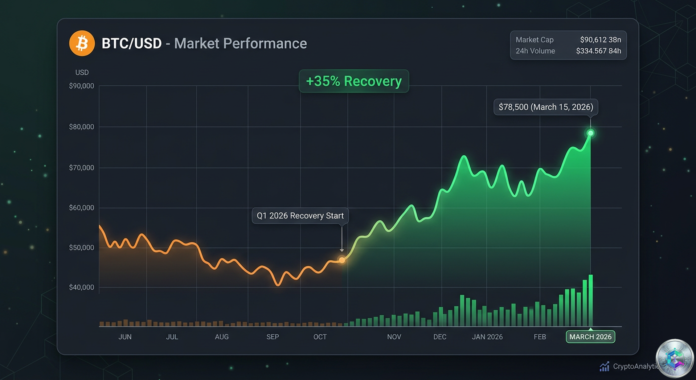
At the time of the report’s publication, Bitcoin was trading at approximately $70,375, up 1.1% in the prior 24 hours, according to The Block’s price data. The cryptocurrency experienced increased volatility in recent weeks, weighed down by persistent geopolitical uncertainty and the Federal Reserve’s decision to maintain interest rates — signaling a hawkish outlook for the U.S. economy.
Earlier this week, BTC had briefly reached $76,000 before retreating below $71,000 amid renewed Fed caution. The crypto market lost more than $100 billion in capitalization over 24 hours in a broad selloff that also hit global equity markets.
Analysis: A Precarious but Encouraging Balance
The VanEck report paints the portrait of a market in precarious balance but whose some fundamental indicators are improving. The reduction in long-term holder selling pressure is a positive factor: these actors are generally considered the most informed, and their holding behavior suggests conviction in Bitcoin’s medium-term value.
The relative stability of miner sales, despite deteriorating profitability, is also a sign of resilience. Mining operators apparently prefer to wait for improved price conditions rather than sell in panic — rational behavior that could shift if the bear market prolongs.
Finally, some miners’ migration toward AI, while suggesting difficulties for traditional mining, illustrates the sector’s flexibility and capacity to reinvent itself. Some analysts even see this as a long-term bullish signal: reduced Bitcoin mining demand could lower competition and network difficulty — a dynamic historically favorable for holders.
Outlook
The coming weeks will be decisive in confirming or infirming this constructive signal. Investors will closely watch the next on-chain data, particularly the evolution of miner reserves and long-term holder behavior in the event of new downward pressure. The Fed’s next rate decision, expected in the coming weeks, will also remain a key factor for market sentiment.
For now, the $70,000 support remains the critical level for bulls to defend. A break below this threshold could trigger a wave of miner liquidations and revive selling pressure across the market.
Sources:
- VanEck, Mid-March 2026 Bitcoin ChainCheck Report, March 2026
- The Block, Bitcoin price data
- CoinMarketCap Academy

