

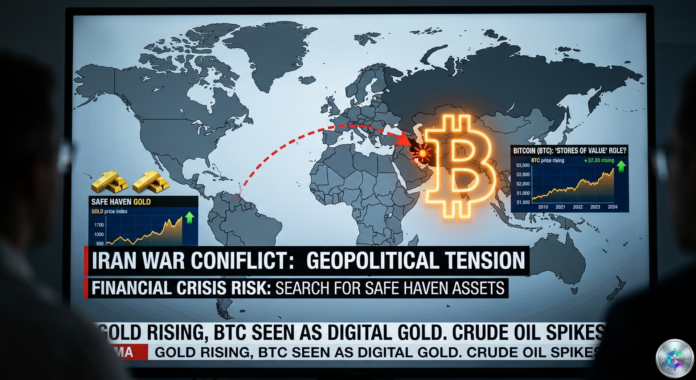
Bitcoin and the Iran War: Safe Haven or the ‘Digital Gold’ Mirage?
As US and Israeli strikes on Iran enter their fourth week, Bitcoin has recovered above $71,000. But this rebound masks a more nuanced reality: the crypto remains desperately correlated with risk assets, and its role as a safe haven remains unproven.
Unexpected Resilience Amid Geopolitical Chaos
On February 28, 2026, the United States and Israel launched their first strikes against Iran. Far from the crash some had feared, Bitcoin initially wobbled to $63,176 before bouncing roughly 12% back to around $71,000 in early March. A performance that, on paper, would make many traditional assets blush.
But this rebound deserves to be dissected. Because the context in which it unfolds is far from favorable to risk assets: maximum geopolitical tensions, oil prices surging above $110 per barrel, and inflation fears revived by the closure of the Strait of Hormuz — through which roughly 20% of the world’s oil trade transits.
Meanwhile, gold — the ultimate safe haven asset — plummeted 11% last week, its largest weekly decline since 1983. Some saw this as proof that a new era was dawning for Bitcoin: one where crypto would finally dethrone gold as the ultimate store of value.
Alas. Analysts remain cautious.
The Safe Haven Mirage: What the Data Really Reveals
Jonatan Randin, senior market analyst at PrimeXBT, pulls no punches: « Bitcoin continues to trade like a risk asset rather than a safe haven. It sells off alongside equities during geopolitical shocks. It’s range-bound and showing weakness within a broader downtrend. That’s not safe haven behavior. »
An analysis that technical data confirms. Every escalation of the conflict has triggered mass selloffs, liquidation cascades, and tighter correlation with equities. While Bitcoin has held up better than the S&P 500, gold, and silver over certain periods, it has failed to generate a meaningful directional move.
Matthew Pinnock, co-founder of decentralized finance project Altura, agrees: « BTC is trading as a high-beta liquidity asset, which means tighter financial conditions — such as higher real yields, a strong dollar, and weaker ETF inflows — reduce marginal capital and pressure price. »
Global Liquidity: Bitcoin’s True Driver
This is where the problem lies. For years, on-chain data and academic studies have converged on one point: global liquidity is the dominant factor driving Bitcoin’s price.
An analysis published in September 2024 by Sam Callahan of treasury company OranjeBTC revealed a 0.94 correlation between Bitcoin’s price and global liquidity (global M2) between May 2013 and July 2024. More striking: Bitcoin moved in the same direction as global M2 money supply in 83% of 12-month periods — a score higher than gold’s (68.1%) and even the S&P 500’s.
Put simply: when major central banks inject liquidity into the system (accommodative monetary policies, Quantitative Easing), Bitcoin tends to rise. When they tighten the taps (rate hikes, QT), Bitcoin suffers — regardless of geopolitical headlines.
Randin confirms this with more recent data: « The most recent data reflects a similar pattern, with global liquidity rising in the third quarter of 2025, around the time when Bitcoin reached a new all-time high. »
This divergence highlights a structural problem with Bitcoin’s safe haven narrative. While it has outperformed gold since the Iran conflict began, its sensitivity to liquidity conditions means it reacts more to financial tightening than to geopolitical stress itself. This seriously complicates the idea of Bitcoin as « digital gold » — particularly in environments where inflation and rates move in tandem.
The Oil Shock That Complicates the Inflation Narrative
The Iran conflict propelled oil prices above $110 per barrel, with supply disruptions compounded by the closure of the Strait of Hormuz — through which roughly a fifth of the world’s oil commerce passes. This energy surge revived inflation fears that had lain dormant since the post-pandemic calm.
For Randin, this link is crucial: « Rising inflation concerns tied to geopolitical shocks tend to work against Bitcoin in the short term. Higher oil prices feed into inflation expectations, reduce the likelihood of rate cuts, and keep real yields elevated. This chain of events tightens financial conditions and suppresses risk appetite, limiting demand for assets like Bitcoin. »
The Federal Reserve indeed revised its 2026 PCE inflation forecast upward to 2.7% at its March 2026 meeting, while signaling a more cautious easing path.
Trump’s Tuesday announcement — a pause in strikes on Iran and the sending of a 15-point ceasefire plan — pulled Brent crude back and temporarily calmed markets. Bitcoin accordingly recovered above $71,000.
But the damage to perception is done: Bitcoin is not reacting to inflation itself, but to the policy response that follows.
As Randin puts it: « Bitcoin could be better understood as a long-term monetary debasement hedge rather than a short-term inflation hedge — and that’s a critical distinction. It responds to the expansion of money supply over multi-year cycles, not to CPI prints. On the timescale of a war-driven oil shock, it still behaves like the risk asset it is. »
Risk Profile Remains That of a Risk Asset
If Bitcoin is performing better than traditional assets since the conflict began, the context must not be forgotten.
Randin tempers enthusiasm: « It’s important to remember the context. Bitcoin entered this conflict already in a technical bear market, down over 40% from its October highs and well ahead of equities in pricing in deteriorating conditions. So while it has held up relatively well since the strikes began, outperforming the S&P 500, gold, and silver over certain windows, it hasn’t given us any meaningful directional move. »
A structural shift would require a clear break from this pattern — and those signals have yet to appear.
What On-Chain Data Says: Silent Accumulation
If the price shows no clear direction, on-chain data tells a different story. Persistent outflows from exchanges, declining reserves on trading platforms, and growing holdings among large wallets suggest bullish positioning in the background.
Glassnode data shows that exchange flows have remained negative for several weeks — a sign that investors are transferring their BTC from exchanges to personal wallets or cold storage solutions, traditionally viewed as a sign of accumulation.
Nevertheless, this positioning remains constrained by macroeconomic conditions. As Pinnock explains: « Right now, inflation driven by a hike in oil prices due to geopolitical factors is pushing yields higher and keeping central banks hawkish, which tightens liquidity. This creates a ‘bad inflation’ regime where BTC falls alongside other risk assets. The inflation hedge thesis breaks because Bitcoin responds more to monetary expansion than to inflation itself — and currently, conditions are restrictive, not stimulative. »
Bitcoin Against History: Precedents That Raise Questions
It is worth recalling that this is not the first time Bitcoin has been presented as a refuge in times of crisis. In 2022, during Russia’s invasion of Ukraine, crypto initially plunged with equity markets before recovering. In 2020, during the Covid crash, the same pattern: violent initial drop, then vigorous rebound fueled by massive stimulus packages.
In every case, the trigger for the rebound was not the crisis itself, but the monetary response that followed — namely, the massive injection of liquidity by central banks.
Iran is no exception to the rule. The 15-point ceasefire proposal sent by the Trump administration helped pull oil back and calm markets. But as long as the Federal Reserve and other major central banks remain on a restrictive trajectory, Bitcoin will struggle to break free from its correlation with equities.
The Role of Bitcoin ETFs: The Now-Silent Price Regulator
One often-overlooked factor in this equation: spot Bitcoin ETFs, launched in January 2024 in the United States, have profoundly changed BTC’s price dynamics. These investment vehicles, now holding tens of billions of dollars in Bitcoin, act as a stabilizer — but also as an amplifier of the trend.
When flows are positive, ETFs buy Bitcoin on the market, pushing the price up. When flows reverse — as was the case in Q4 2025 with the Fed’s restrictive drift — ETFs become a source of selling pressure.
In March 2026, ETF flows remain mediocre. According to Glassnode data, cumulative net inflows since the start of the year were negative in February before tentatively recovering in March. A signal that institutional appetite for Bitcoin remains conditional — and directly tied to monetary policy prospects.
As Pinnock noted, « a strong dollar and weaker ETF inflows reduce marginal capital and pressure price. » This remark underscores that Bitcoin cannot break free from macro-financial conditions as long as its institutional adoption remains subject to risk cycles.
This reality has a direct implication for retail investors: monitoring Fed decisions and ETF flows may be as important — if not more — than following geopolitical developments to anticipate Bitcoin’s movements.
The Question That Determines What Comes Next: Can Bitcoin Really Become a Safe Haven?
For the safe haven narrative to hold, several conditions should be met:
1. Sustainable decoupling from equities — For now, Bitcoin still follows stocks during stress. It has never sustainably separated from the S&P 500 during crashes.
2. An independent response to global liquidity — If Bitcoin only rises when central banks print money, it remains a monetary policy tool, not a refuge.
3. Consistently superior performance during crises — A few weeks of resilience are not enough. Bitcoin would need to demonstrate this superiority across multiple crisis cycles.
4. Institutional adoption as a store of value — MicroStrategy’s or Tesla’s declarations of Bitcoin purchases are symbolic. But central banks, sovereign funds, and insurers have not yet massively integrated Bitcoin into their reserves.
Verdict: An Encouraging Rebound, But Not a Revolution
Bitcoin’s rebound during the Iran conflict is encouraging for its supporters. Crypto outperformed gold, stocks, and precious metals over certain periods — a sign that the digital gold narrative is gaining ground.
But fundamentals tell a different story. Cryptocurrency remains desperately correlated with global liquidity and overall financial conditions. Its behavior during geopolitical tension peaks remains that of a risk asset: it falls during escalations, recovers when conditions ease, but shows no ability to rise sustainably when everyone else is falling.
The real question is therefore not « Is Bitcoin a safe haven today? » The real question is: « Will Bitcoin become a safe haven one day, and if so, under what conditions? »
The answer likely lies less in the technical characteristics of crypto than in the decisions of central banks. As long as monetary policy remains restrictive and ETF flows remain weak, Bitcoin will struggle to break free from its identity as a risk asset.
In the meantime, Bitcoin remains what it has always been: a bet on the future of the monetary system — and a convenient geopolitical distraction tool for markets.
Keywords: Bitcoin, Iran, war, safe haven, digital gold, global liquidity, bitcoin price, BTC, bear market, geopolitical conflict, Federal Reserve, oil, inflation, M2, correlation, stocks, Ethereum, crypto, cryptocurrency, analysis, investment strategy

