

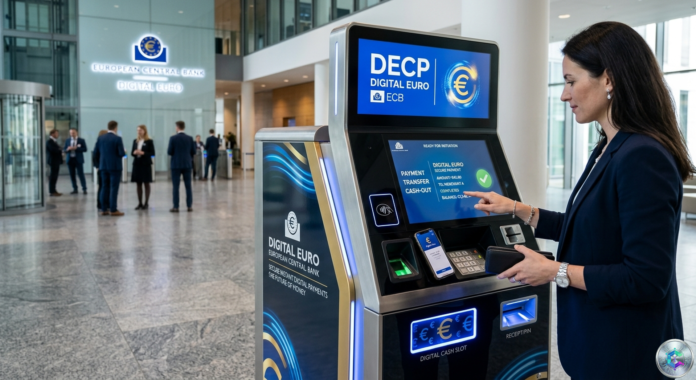
On March 19, 2026, Cointelegraph published a major announcement: the European Central Bank (ECB) has officially kicked off the work to integrate the digital euro into ATMs and payment terminals across the European Union. This move fits within a broader framework of modernizing payment methods and strengthening European monetary sovereignty in the digital era.
The stakes are high. With a European population that spends hundreds of billions of euros each year through digital means, the digital euro could become a key component of the payment ecosystem. Early tests will include offline transaction scenarios.
ECB Workstreams
The ECB is organizing the work around two strategic axes:
1) Implementation specifications
– Definition of a technical framework for the issuance, distribution, and spending of the digital euro within ATMs and payment terminals.
– Definition of communication protocols, API interfaces, and authentication and security mechanisms.
– Collaboration with sector players to ensure smooth integration.
2) Certification
– Establishment of a certification framework guaranteeing interoperability and security.
– Definition of performance criteria and compliance testing.
Integration with ATMs and Terminals
Integrating the digital euro into ATMs and payment terminals requires an evolution of existing architectures. Current ATMs must be capable of generating and exchanging secure, traceable digital value units.
Offline Transactions and Interoperability
One of the most crucial aspects is the ability to carry out offline transactions with the digital euro while ensuring interoperability between national and cross-border networks:
– Enable payments without network connectivity.
– Ensure interoperability between different platforms.
Towards a 2027 Pilot
The ECB announcements indicate that an operational pilot could be deployed as early as 2027. The pilot would aim to demonstrate the feasibility of the digital euro at scale.
Implications
The introduction of the digital euro into ATMs and payment terminals could have profound implications for Europe’s payment ecosystem. For central banks, this is a new step in monetary sovereignty. For consumers, the digital euro could offer a faster and more cost-effective payment experience.
Conclusion
The objective is clear: to secure and democratize access to European digital money, prioritizing inclusion and resilience.

