


On March 10, 2026, Polymarket, the world’s largest prediction market platform, announced a landmark strategic partnership with Palantir Technologies (NASDAQ: PLTR) and TWG AI to deploy a cutting-edge AI surveillance infrastructure dedicated to sports betting integrity. Powered by the Vergence AI engine, this system marks a pivotal turning point for an industry facing intense regulatory pressure and a series of high-profile insider trading scandals.
A High-Profile Strategic Partnership
Polymarket describes this initiative as a « next-generation sports integrity platform, » aiming to establish new surveillance standards for sports-related prediction markets — a segment that has exploded in popularity, attracting billions of dollars in trading volume.
Shayne Coplan, founder and CEO of Polymarket, stated: « Our partnership with Palantir and TWG AI allows us to apply world-class analytics and surveillance to sports markets. » For his part, Alex Karp, co-founder and CEO of Palantir, declared that this alliance « will define a new standard for prediction markets, » stressing that the expansion of the sports segment demands a high level of governance competitiveness.
Polymarket has also engaged Integrity Compliance 360 (IC360), a specialized sports betting surveillance firm that already works with the major American professional leagues (NFL, NBA, MLB, NHL) as well as major operators like DraftKings and FanDuel.
Vergence AI: The Technology at the Core
The Vergence AI engine was born from a joint venture announced in March 2025 between Palantir Technologies and TWG Global. This venture, led by Alex Karp and the senior leadership of TWG Global — Mark Walter, Thomas Tull, and Drew Cukor — was designed to redefine AI deployment across financial services, insurance, and investment management.
Drew Cukor, Chief Data & Analytics Officer at TWG Global, is notably recognized for having led the AI initiatives of the Pentagon’s Project Maven and JPMorgan Chase — two benchmarks for large-scale AI deployment. The partnership draws on more than two decades of collaboration in critical domains including defense, government, and commercial applications.
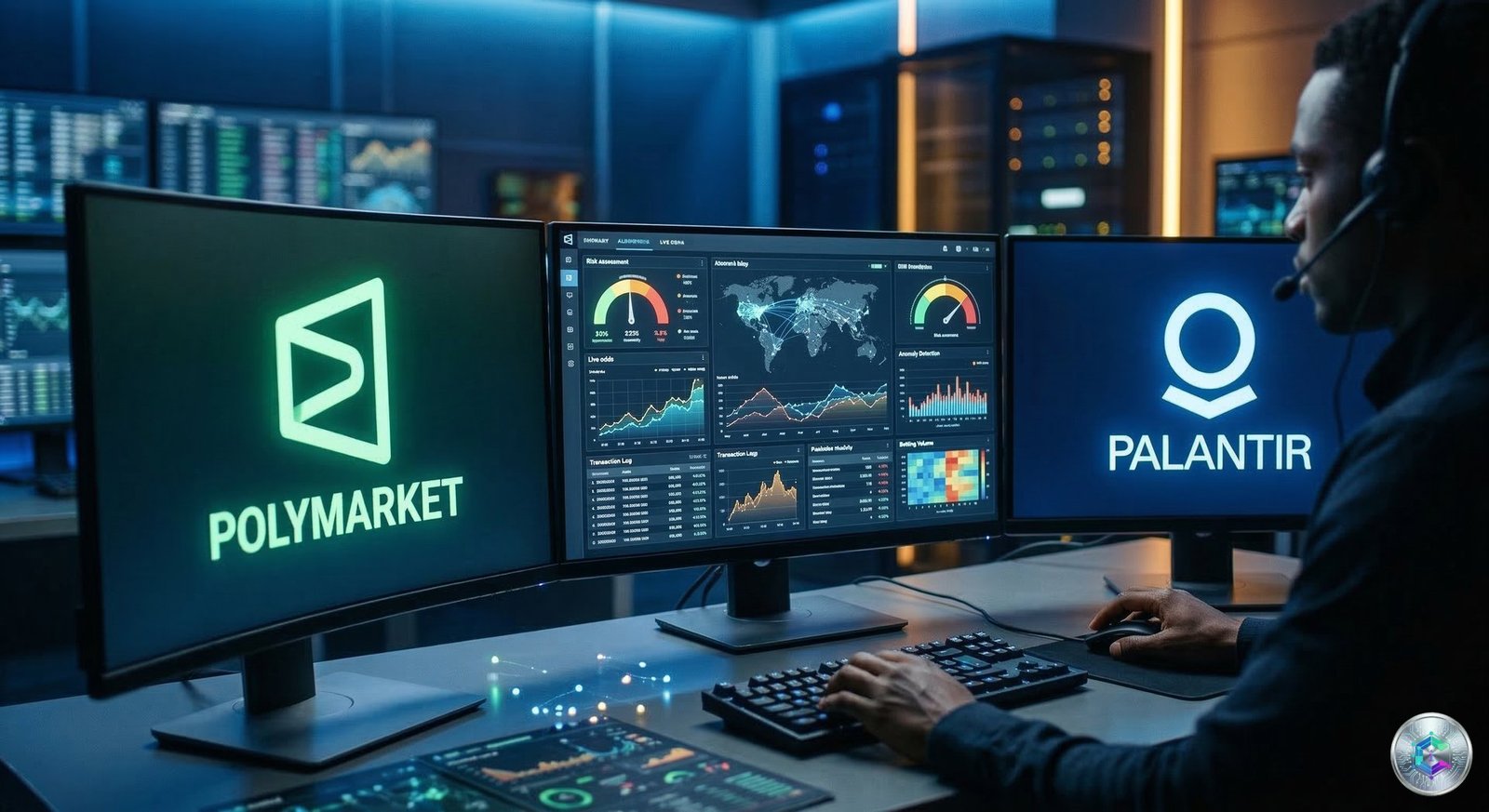
Key Features of the Surveillance System
The deployment of Vergence AI on Polymarket covers a comprehensive set of capabilities:
- End-to-end transaction surveillance: integrity monitoring before and after each transaction, covering the full order flow, execution data, and settlement operations.
- Real-time anomaly detection: near-instantaneous identification of potential market manipulation, coordinated activity, insider risks, and irregular market patterns.
- Banned trader filtering: analysis of user relationships and cross-referencing against restricted participant databases within the sports betting industry.
- Surveillance operations center: triage workflows, escalation protocols, case management tools, and audit-ready reports.
- Automated compliance reporting: generation of alerts, documentation, and supervisory records for regulators and sports leagues.
This deployment represents one of the first major public commercial applications of the Vergence AI engine, which had remained relatively low-profile until this announcement.
An Urgent Response to the Insider Trading Crisis
This partnership comes in the wake of a series of serious scandals that have shaken Polymarket’s credibility in recent months:
- January 2026 — The Maduro Affair: A user who had created their account just weeks prior bet $32,000 on the fall of Nicolás Maduro and pocketed over $400,000 just hours before Trump ordered the capture operation. The trader’s identity remains unknown despite investigations.
- February–March 2026 — Iran Strike Bets: Over 150 users each bet at least $1,000 on a U.S. strike against Iran the day before the attack. An account named « MAGA » placed $87,000 exactly 71 minutes before the first strikes, winning $515,000. Democratic senators subsequently called for the platform to be shut down.
- December 2025 — The Google Affair: A trader made $1.2 million by betting with extraordinary precision on Google Search results. A Google employee was identified as potentially involved, with a winning record of 22 out of 23 bets.
- March 2026 — Israeli Indictment: An IDF reservist and a civilian were indicted for corruption and obstruction of justice for using classified military intelligence to place bets on Polymarket, generating approximately $150,000 in gains.
This Palantir partnership marks a 180-degree reversal for Polymarket. As recently as December 2025, Shayne Coplan was still claiming the platform could « self-regulate » through users flagging suspicious activity on X (Twitter). That approach has clearly proven inadequate in the face of these mounting scandals.
A Sector in Regulatory Transformation
The regulatory landscape for prediction markets in the United States is undergoing a profound shift in 2026. The new CFTC chairman, Michael S. Selig, outlined an ambitious four-pronged agenda in January 2026: withdrawing the 2024 rule that would have banned event contracts linked to sports and politics, establishing clear new regulatory standards, reaffirming the CFTC’s exclusive jurisdiction over derivative markets, and intensifying enforcement via a « Prediction Markets Advisory » published in February 2026.
Federal prosecutor Jay Clayton of the Southern District of New York explicitly warned that placing a bet on a prediction market « does not protect you from fraud charges » and announced that legal actions are forthcoming. Representative Ritchie Torres introduced the Public Integrity in Financial Prediction Markets Act of 2026, which would ban government employees with access to non-public information from trading on prediction markets.
Polymarket’s main rival, Kalshi, which has operated under a CFTC license since its 2024 legal victory, has already submitted two potential insider trading cases to the CFTC and plans to publish quarterly transparency reports on suspicious activity. Kalshi recorded over $1 billion in trading volume on Super Bowl Sunday alone.
Stratospheric Valuations: Racing Toward $20 Billion
According to the Wall Street Journal, Polymarket and Kalshi are in preliminary fundraising discussions that would value each company at approximately $20 billion — nearly double their late-2025 valuations.
| Platform | Valuation (Dec. 2025) | Target Valuation | Latest Funding |
|---|---|---|---|
| Kalshi | $11 billion | ~$20 billion | $1B (Sequoia, CapitalG, a16z) |
| Polymarket | $9 billion | ~$20 billion | ICE (NYSE) investment up to $2B |
The combined trading volume of both platforms reached approximately $18.3 billion in February 2026, up from under $2 billion in August 2025. Kalshi has reached an annualized revenue run rate of approximately $1.5 billion.
Polymarket was banned from the U.S. market in 2022 by the CFTC for operating an unregistered derivatives platform. Its comeback was engineered through the acquisition of QCX (renamed QCEX), a CFTC-registered clearinghouse, for $112 million. In November 2025, the CFTC officially validated Polymarket’s regulated return, allowing U.S. users to trade via FCMs (Futures Commission Merchants) and traditional brokers. The Vergence AI surveillance system is specifically designed for this new regulated platform — a prerequisite for achieving the $20 billion valuation target.
DraftKings Enters the Arena
Online sports betting giant DraftKings (NASDAQ: DKNG) launched DraftKings Predictions in late 2025, a CFTC-regulated mobile app available in 38 states. The company targets $10 billion in gross annual revenues from the prediction markets segment, with margins 10–30% higher than those of its traditional business. DraftKings is also building its own market-making division and pursuing full vertical integration of its exchange platform.
On Super Bowl Sunday, DraftKings Predictions ranked second in downloads in its segment and tripled its daily trading volume record. The arrival of this giant — equipped with a massive user base and a battle-tested regulatory infrastructure — represents a serious competitive threat to both Polymarket and Kalshi.
Conclusion: Integrity as a Condition of Survival
Prediction markets are at a crossroads in 2026. The era in which Polymarket could rely on Twitter as a de facto regulator is over. Faced with pressure from the Department of Justice, sweeping new CFTC regulations, competition from DraftKings, and insider trading scandals implicating military personnel and potentially individuals connected to political power, the alliance with Palantir was inevitable.
As Carlos Pereira, General Partner at BITKRAFT Ventures, notes, insider trading concerns « could become a serious obstacle for the industry if left unaddressed. » The question is no longer whether prediction markets will be regulated, but how. And Polymarket’s answer — integrating the most advanced surveillance AI rather than waiting for sanctions to arrive — may well prove to be the smartest bet in the platform’s history.

