


The rise of AI agents capable of conversing, using tools, and initiating payments is creating a new critical link in digital infrastructure: who decides that work has actually been completed before releasing funds? On one side, tech giants are already standardizing tool connectivity, inter-agent communication, and payment authorization. On the other, a new generation of programmable escrow primitives — ERC‑8183, x402, Agent Escrow Protocol — is attempting to make this « judgment moment » a neutral space governed by smart contracts rather than closed platforms.
From Conversational AI to Agents That Pay
The first large language models (LLMs) like ChatGPT, Gemini, or Claude were primarily confined to text generation and information retrieval. In 2025–2026, the dominant trend is autonomous agents: systems capable of planning, calling APIs, interacting with websites, and chaining end-to-end actions.
Platforms like Anthropic, Google, and multiple open-source frameworks have generalized agents’ ability to connect to external tools, retain memory, and coordinate multiple subtasks. The natural next step is giving them the ability to settle invoices, compensate other agents, or purchase resources — compute, data, APIs — without human intervention at each step.
Initiatives like OpenClaw illustrate agents capable of acting on a local PC or server to manage emails, calendars, or simple purchases, while still stumbling on the final payment step. Other agent commerce projects already automate the conversion of crypto into real purchases via virtual cards, with funds held in on-chain escrow contracts until task validation.
The Current Agentic Commerce Stack: What It Solves — and What It Doesn’t
Much of the AI agent technical stack is already being standardized, but the focus is on connectivity, coordination, and authorization — not on verifying completed work. Several protocols share the upper layers of this stack:
- MCP (Model Context Protocol) by Anthropic — connects agents and applications to external tools and data sources. It now runs on thousands of public servers.
- A2A (Agent-to-Agent) by Google — enables agents to communicate across organizations.
- UCP (Universal Commerce Protocol) by Google — standardizes automated checkout flows with major merchants.
- x402 by Coinbase — a protocol enabling stablecoin payments directly via HTTP, having already processed hundreds of millions of transactions.
- AP2 (Agent Payment Protocol) by Google — based on signed payment mandates precisely defining what an agent is authorized to spend.
- Verifiable Intent by Mastercard — logs and proves what a user has authorized.
All these protocols primarily answer the question: « Who has the right to pay what, and how to move money? » None resolves the question of actual delivery. This is what analysts call the « authorization-verification gap »: the structural divide between the ability to sign a payment and the ability to judge whether the result actually matched the order. This is precisely the gap crypto is attempting to fill.
ERC‑8183: Programmable Escrow as the Missing Primitive
Published in late February 2026, ERC‑8183 is an Ethereum standard proposal that formalizes a simple state machine for task-based transactions. The sequence is minimal yet elegant:
- A client opens a job and deposits funds in escrow
- The service provider submits the work
- An evaluator marks the job as completed or rejected
- An expiry automatically refunds the client if nothing happens
The standard defines four states: Open, Funded, Submitted, Terminal. Only the evaluator can mark a job as done. Within the Ethereum community, it’s noted this is neither an AI nor a specifically « agentic » concept, but a job registry with escrowed funds — which is precisely its strength: a generic primitive for any deliverable-based commerce, human or machine.
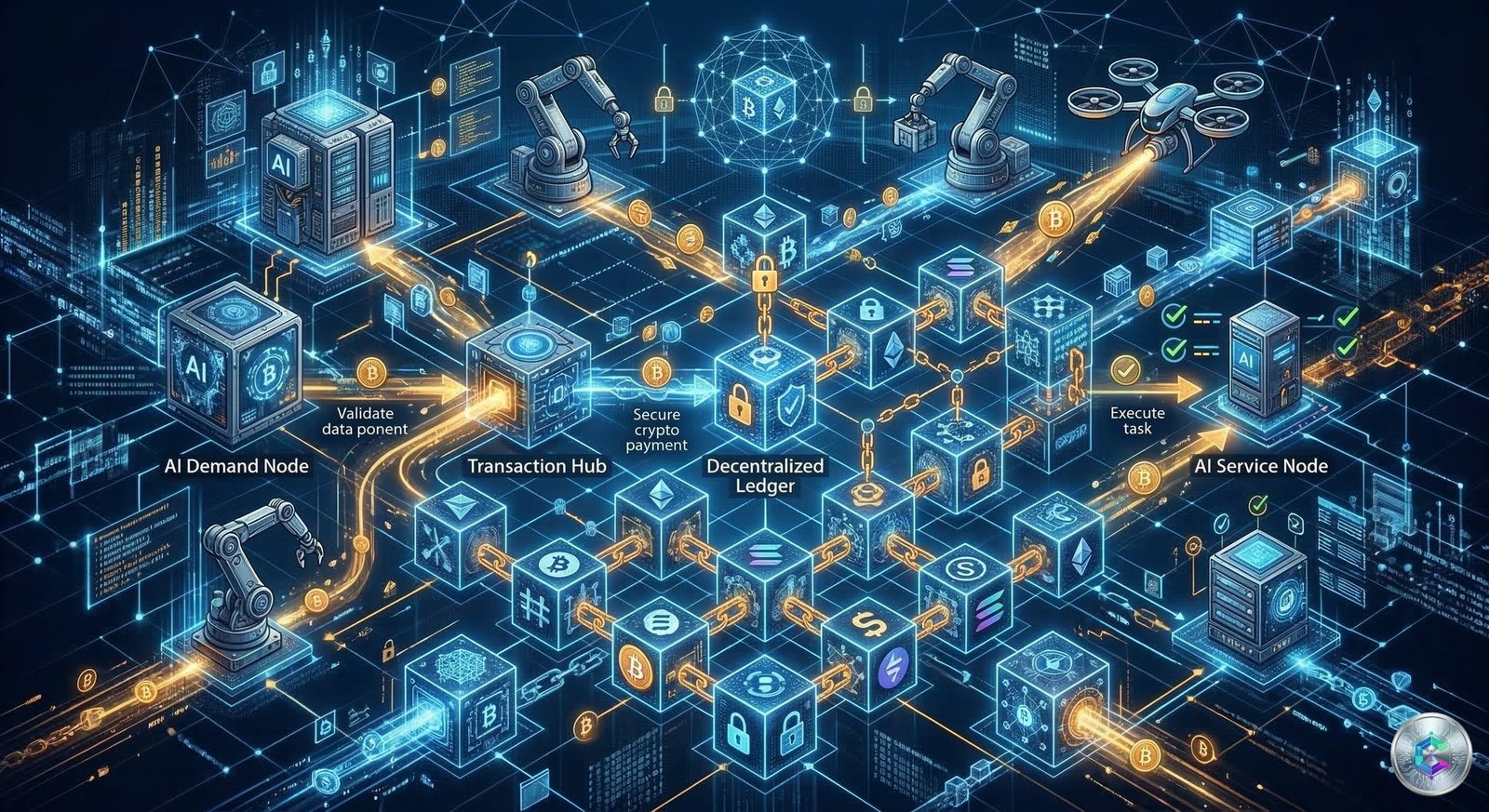
The « agentic » dimension comes from composing ERC‑8183 with other building blocks: ERC‑8004 (reputation and trust for agents), decentralized oracles, staking systems, or zkML (zero-knowledge machine learning) proofs attesting that certain conditions are met. In this architecture, AI agents don’t unilaterally decide to release funds — they interact with an escrow contract that enforces a clear, auditable, programmable state path.
Why Escrow Is at the Heart of the Problem
In the traditional world, escrow serves as a trusted third party to hold funds until both parties confirm a contract has been honored — but relies on intermediaries that are slow, expensive, and subject to regulatory constraints. In a world of autonomous agents exchanging micropayments and services 24/7, these frictions become incompatible with the pace of machine-to-machine commerce.
Smart contract escrow shifts this role to code: funds are locked on-chain, release conditions are public and immutable, and no centralized entity can divert or freeze funds without it being written into the contract. This perfectly matches the nature of AI agents, which are themselves code and need a settlement layer that is natively software, independent of banking hours or human KYC requirements.
Without on-chain escrow, the agent economy would be condemned to recentralize around platforms acting as gatekeepers, recreating the same power concentrations as Web2.
Truly autonomous agents, without a legal human entity behind them, cannot open bank accounts or comply with the current payment infrastructure model. Crypto becomes not a choice, but a structural necessity.
Case Studies: Where AI and Escrow Already Meet
Circle: AI-Powered Escrow on Stablecoins
Circle, the issuer of USDC, has demonstrated an AI-powered escrow agent prototype combining multimodal models with smart contracts. The system automatically parses PDF contracts, extracts key terms, deploys corresponding escrow smart contracts, and verifies task completion — including via image analysis — before triggering settlement. Funds flow in USDC across multiple blockchains via Circle’s Cross-Chain Transfer Protocol, enabling near-instant settlements where traditional processes would take days.
Multi-Chain Agent Commerce: Real Purchases via Escrow
Projects like Interact, presented at Web3 hackathons, allow users to deposit funds in a multi-chain escrow contract (Hedera, Flare, Flow) to request an AI agent to perform real tasks: order a pizza, book a flight, or make purchases on Amazon. The agent acts as a human proxy, using virtual cards and payment APIs, but can only claim compensation once the task is validated by the user or after a predefined delay. Non-execution cases trigger automatic full refunds.
Agent Escrow Protocol: On-Chain Reputation for AI Agents
Agent Escrow Protocol introduces an on-chain reputation and credit scoring system for agent-to-agent payments on Base, relying on USDC. Each interaction updates a shared reputation registry: a correctly completed mission earns a positive point, while disputes adjust both parties’ reputations. This registry becomes a public trust infrastructure for the agent economy — enabling any new agent or client to review a counterparty’s history before engaging them.
Crypto’s Structural Advantage — and Its Blind Spots
Crypto presents several characteristics structurally aligned with AI agent needs: 24/7 transactions, near-instant settlement, absence of human gatekeepers, native programmability via smart contracts, and transparent registries. As leaders like Mark Zuckerberg anticipate hundreds of millions, even billions, of autonomous agents, the need for software-native payment infrastructure becomes hard to ignore.
However, Big Tech is advancing rapidly on the authorization and merchant integration layer. If these players manage to integrate pseudo-verification mechanisms atop their proprietary rails, they could capture the « judgment moment » inside walled gardens, relegating crypto to a peripheral role.
Crypto primitives still face real challenges: governance (who truly controls the evaluator, even if they’re on-chain?), UX (wallet management, security), and regulation, especially for fiat interfaces. There’s no guarantee that a standard like ERC‑8183 will reach critical adoption before standards are imposed by the card + big tech ecosystem.
Three Scenarios for the Future
Several trajectories are emerging for the coming years:
- « Big Tech First » scenario: Agent hosts (cloud giants, AI platforms, payment networks) integrate escrow and verification themselves, capturing most of the value from agent-to-agent payments.
- « Crypto Rail » scenario: Standards like ERC‑8183, x402, and multi-chain escrow protocols become the neutral primitives upon which open agent markets are built.
- Hybrid scenario: Coexistence of closed silos for large accounts alongside open ecosystems of specialized agents, financed and settled via crypto.
Conclusion: The Real Stakes Aren’t the Token — It’s the Judgment
The layer that will capture the most value in the agent economy will likely be neither the language model nor the simple payment rail, but the infrastructure that controls the conditional moment when funds are released. This is what programmable escrow aims to capture: not the data flow between agents, but the tipping point where a judgment — human, oracle, model, or combination of the three — transforms declared work into distributed money.
For the crypto ecosystem, the real challenge is not just that agents pay in tokens rather than fiat, but that they can do so through an escrow and judgment layer that remains neutral, programmable, and resistant to capture. It is this battle for the « escrow moment » — that precise point where a payment becomes irreversible — that could ultimately decide whether the agent economy remains open or slides toward a new Web2.

