

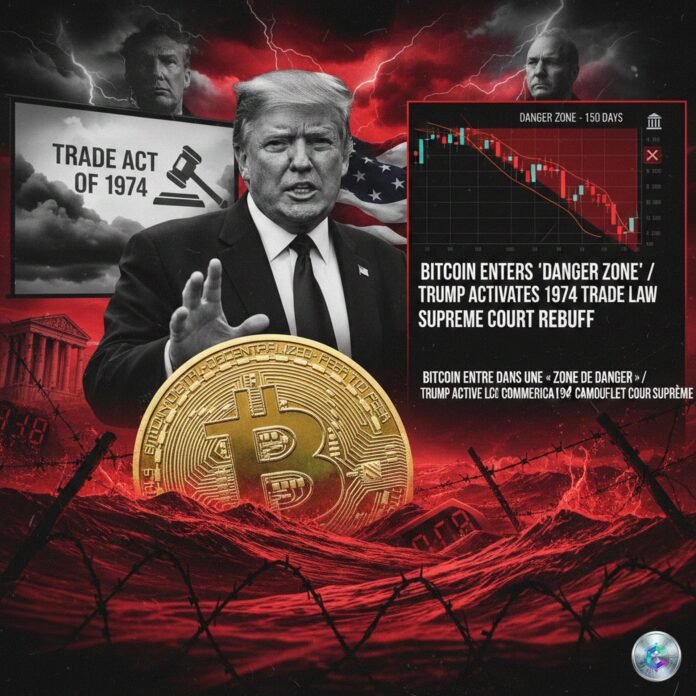
On February 20, 2026, the U.S. Supreme Court issued a landmark ruling, striking down 6-3 the tariffs imposed under the International Emergency Economic Powers Act (IEEPA) of 1977. Within hours, Donald Trump activated a 50-year-old trade law, plunging Bitcoin and financial markets into unprecedented uncertainty.
A Landmark Supreme Court Ruling
On February 20, 2026, the U.S. Supreme Court ruled decisively: the IEEPA of 1977 does not authorize the president to impose tariffs. Justices Roberts, Gorsuch, and Barrett invoked the « major questions doctrine, » while Kagan, Sotomayor, and Jackson reached the same conclusion through ordinary textual interpretation of the statute. Only Kavanaugh, Thomas, and Alito filed a dissent, warning of the « disorder » this ruling could unleash — particularly regarding the billions of dollars potentially owed in refunds.
The Court underscored that a tariff is « very clearly a branch of the taxing power, » reserved for Congress under Article I of the Constitution. It characterized the administration’s interpretation as a « transformative expansion » of presidential authority — one Congress would never have delegated through general language about « regulating imports. »
Trump’s Immediate Pivot to Section 122
Within hours, Trump signed an executive order invoking Section 122 of the Trade Act of 1974, imposing a blanket 10% tariff on nearly all imports, effective February 24. Less than 24 hours later, he raised the rate to the statutory ceiling of 15%, immediately exhausting the full margin available under this law.
No president had ever previously invoked Section 122. The law allows the president to impose temporary surcharges of up to 15% for a maximum period of 150 days when the United States faces a « large and serious » balance-of-payments deficit. After that window closes, only Congress can extend the tariffs.
« A balance of payments deficit is not the same thing as a trade deficit. With a flexible exchange rate, as the U.S. currently has, you cannot have a balance of payments deficit. »
Peter Berezin, Chief Strategist, BCA Research
A Legally Contested Foundation
Economists and legal experts immediately questioned the validity of invoking Section 122. Bryan Riley, Director of the Free Trade Initiative at the National Taxpayers Union, explained that the provision only makes sense under a fixed exchange rate system — a regime the United States abandoned more than 50 years ago. Since the adoption of floating exchange rates in 1973, the mechanism self-adjusts, making Section 122 « effectively obsolete, » according to Riley.
The Council on Foreign Relations (CFR) also noted that Section 122 measures must be applied uniformly and cannot target individual countries, severely limiting their strategic reach. The law therefore cannot substitute for the country-specific tariffs on China, Canada, and Mexico that had been imposed under anti-fentanyl authority.
$133 Billion in Potential Refunds Hanging in the Balance
The ruling opens the door to massive refund claims. According to U.S. Customs and Border Protection (CBP) data, $133.5 billion in IEEPA duties had already been collected as of mid-December 2025. The Penn Wharton Budget Model projects potential refunds of up to $175 billion.
However, the Supreme Court did not address the mechanics of refunds. Importers typically have 180 days after the « liquidation » of their goods to contest and file claims with CBP. According to TD Securities, the process could take 12 to 18 months. Consumers are unlikely to see direct refunds — it is importing businesses that will be the primary beneficiaries.
Bitcoin’s Reaction: A Telling Pop-and-Drop
Bitcoin reacted instantly to the ruling, surging roughly 2% and briefly topping $68,000 within minutes. But the bullish move was fleeting: sellers took control almost immediately, pushing the price back below $67,000. This « pop-and-drop » pattern has become emblematic of crypto markets in 2026, where even positive catalysts struggle to sustain buyer follow-through.
On Monday, February 23, Bitcoin dropped more than 5%, falling below $64,400 before stabilizing around $65,870. Ethereum declined 5.5% to $1,863. This selloff is part of a prolonged downtrend: since its peak above $125,000 in October 2025, Bitcoin has shed more than 47% of its value. Year-to-date losses for 2026 now stand at 26%.
Markus Thielen, Head of Research at 10x Research, argues that the decline is less tied to any single event than to low liquidity and a generalized lack of market confidence — hallmarks of a bear market. He anticipates further losses toward the $50,000 level before a durable floor is established.
The Macroeconomic Transmission Channels
Tariffs affect Bitcoin through several interconnected channels. A 15% blanket tariff acts as a border tax, potentially accelerating inflation and keeping real yields elevated — tightening financial conditions and weighing on high-volatility assets. If tariffs trigger an economic slowdown, markets may price in Fed easing, which would be favorable for Bitcoin. Conversely, rising yields paired with a strong dollar tighten financial conditions further, creating a headwind for BTC.
JPMorgan estimates the average effective tariff rate will settle around 9–10%, but warns that « trade uncertainty in the months ahead will remain elevated. »
Trump’s Replacement Strategy: A Legal Patchwork
Section 122 is only a temporary bridge. The CFR notes that Trump will need to rebuild his tariff regime as a « patchwork, » since no single available tool can replicate the near-unlimited authority IEEPA once provided. The administration does, however, have several alternative levers at its disposal:
| Legislative Tool | Scope | Tariff Ceiling | Key Limitation |
|---|---|---|---|
| Section 122 (Trade Act 1974) | Global, uniform | 15% max | 150-day maximum |
| Section 232 (Trade Expansion Act 1962) | Sector-specific (national security) | No ceiling | Limited to specific sectors |
| Section 301 (Trade Act 1974) | Country-specific (unfair practices) | No ceiling | Requires formal investigation (2–3 months) |
| Section 338 (Tariff Act 1930) | Country-specific (discrimination) | 50% max | Never used; legal status uncertain |
The 150-Day Countdown: What Traders Are Watching
The temporary nature of Section 122 creates a unique market dynamic. Time-limited tariffs shift behavior: they incentivize front-loading (accelerated imports ahead of expiration), intensified lobbying, and a constant stream of headlines around implementation and litigation. The Cato Institute has also flagged a potential loophole: nothing explicitly prevents the president from allowing tariffs to expire after 150 days and then declaring a new emergency to reimpose them — potentially extending uncertainty well beyond the initial window.
Key indicators for traders to monitor in the coming weeks include U.S. Treasury yields (10-year and real rates), the dollar (DXY), credit spreads, and international responses — particularly the impact on bilateral trade agreements with Japan, the EU, and South Korea, as well as Trump’s planned visit to China on March 31.
The market finds itself caught between two competing narratives: inflationary risk on one side, recessionary risk on the other. Until that tension resolves, Bitcoin may continue oscillating in a volatile consolidation range — characteristic of a market that is « listening » but not yet deciding.
Sources: CryptoSlate, BBC News, Fortune, Council on Foreign Relations (CFR), Politico, CNBC, Reuters, Holland & Knight, JDSupra, Bitcoin Magazine, Penn Wharton Budget Model, NPR, Al Jazeera

