

Uniswap Labs has reached a pivotal milestone by equipping AI agents with a concrete, modular toolkit to operate directly on its protocol. Seven new open-source « Skills » have just been released, paving the way for a fully AI-driven decentralized finance ecosystem.
A Landmark Announcement for Agentic DeFi
On February 20, 2026, Uniswap Labs officially unveiled seven new open-source modules — called « Skills » — specifically designed to enable artificial intelligence agents to execute operations directly on the Uniswap protocol. Available through the uniswap-ai GitHub repository, these tools provide structured and secure access to the protocol’s core functions.
The team summarized the announcement with a punchy tagline: « Agents execute on Uniswap. » This update marks the official starting point for building agentic onchain workflows, positioning Uniswap as the first major DeFi protocol to fully embrace the era of algorithmic autonomy.
The 7 Skills: A Full Operational Toolkit
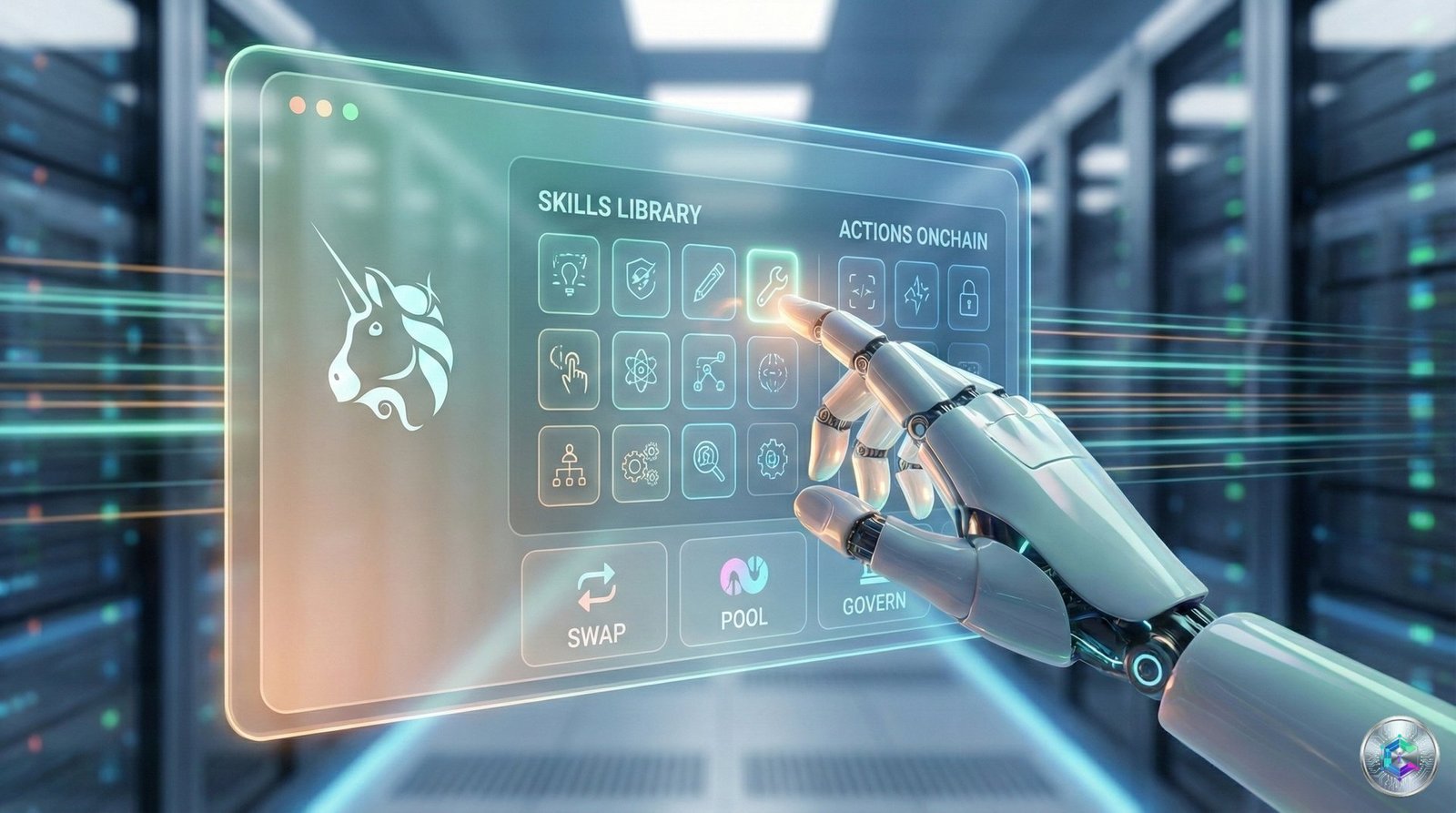
The seven Skills cover the complete operational lifecycle on Uniswap, from security foundations to live trade execution:
| Skill | Core Function |
|---|---|
| v4-security-foundations | Security guardrails and foundations for Uniswap V4 |
| configurator | Smart contract configuration and deployment parameters |
| deployer | Contract and hook deployment for Uniswap V4 |
| viem-integration | Integration with viem/wagmi libraries for EVM interaction |
| swap-integration | Token swap execution |
| liquidity-planner | Liquidity position planning and management |
| swap-planner | Strategic planning of trading operations |
In practice, these modules allow AI agents to quote transactions, execute swaps, manage liquidity positions, and prepare V4 hook deployments — all with built-in guardrails designed to reduce the most common execution errors.
Frictionless Setup for Developers
Uniswap has clearly prioritized reducing friction. The entire toolkit can be installed with a single terminal command:
npx skills add Uniswap/uniswap-aiThe GitHub repository also features integration with the Claude Code marketplace and individual plugins for specific use cases: uniswap-hooks (V4 hook development), uniswap-trading (swap integration), uniswap-cca (CCA auctions), uniswap-driver (swap and liquidity scheduling), and uniswap-viem (EVM integration).
Released under an MIT license, the package is fully open for teams to customize and extend. The repository — written primarily in Python (53.1%), JavaScript (24.1%), and TypeScript (17.4%) — already accumulated 90 stars and 12 forks within hours of its release.
AI Treated as a First-Class Protocol User
This launch signals a profound philosophical shift: Uniswap no longer views AI as a mere analytical tool, but as a primary user of its protocol. Under this new paradigm, AI agents can now:
- Automatically execute trades based on predefined strategies
- Dynamically adjust LP positions in response to market conditions
- Perform market-making and portfolio rebalancing autonomously
- Design and execute composite multi-protocol strategies
Crucially, the Skills are not locked to any single AI model. They are compatible with a range of coding agents and environments, which could significantly accelerate adoption across the rapidly growing autonomous agent ecosystem.
Context: The Rise of Agentic DeFi
Uniswap’s initiative fits into a broader movement toward agent-native decentralized finance. For months, developers have discussed AI systems capable of rebalancing portfolios, harvesting yield, or automatically executing complex transactions. Until now, the tooling remained fragmented and unreliable.
Recent data suggests that AI agents could account for over 30% of onchain activity by the end of 2026. The standardization Uniswap is introducing could accelerate the development of automated traders, intent solvers, and intelligent liquidity managers across the ecosystem.
The announcement also coincides with the upcoming launch of DX Terminal Pro, the first « Onchain Agentic Market » (OAM) on Base, scheduled for February 24, 2026. This project pits AI agents against each other in a 21-day battle royale arena, where agents trade in Uniswap V4 pools with zero human intervention allowed. Uniswap’s new Skills are a foundational building block for this type of competitive platform.
Real Risks That Cannot Be Ignored
Despite the broad enthusiasm, risks remain. Autonomous agents can malfunction if their logic breaks down or if market conditions shift abruptly. Some developers have already warned that production use requires rigorous testing, despite the cleaner interfaces now available.
Key challenges include smart contract security, persistent regulatory uncertainty, and inherent AI model biases. The industry is currently favoring an approach of controlled autonomy, where AI executes bounded tasks with human oversight at critical decision points.
Community Reactions
Early reactions on X (formerly Twitter) have been overwhelmingly positive. Crypto media outlet Wu Blockchain amplified the announcement with a detailed breakdown of the seven Skills. Developers see this as a meaningful step toward fully autonomous onchain trading systems and are already calling on other major DeFi protocols to release similar toolkits.
On Reddit, the r/CryptoCurrency community highlighted the innovative nature of the structured interfaces, which reduce errors and improve reliability compared to previous integrations. Uniswap Labs has invited developers to submit feedback and contributions directly via GitHub.
Is 2026 the Turning Point for AI-Driven DeFi?
If adoption accelerates, 2026 could mark the tipping point from manual DeFi activity to AI-assisted execution at scale. Looking ahead, if other protocols follow suit, AI agents could run complete cross-protocol financial processes: trading on Uniswap, borrowing on Aave, managing yields on Pendle, and performing automatic arbitrage — all without human intervention.
Uniswap is firing one of the first shots in what looks like the next great race for onchain infrastructure. The message is unambiguous: the future of decentralized trading will be agentic, and Uniswap intends to lay the foundations.

