

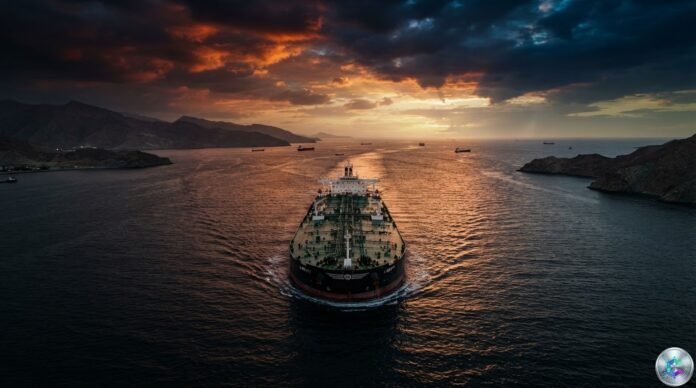
The United States has struck at the heart of Iran’s militarized financial apparatus. On July 29, 2026, the U.S. Treasury sanctioned two Iranian entities accused of transforming the Strait of Hormuz — through which 20.3 million barrels of oil pass daily — into a systematic extortion mechanism, payable in Bitcoin. Iran’s stated goal: generate up to $10 billion in revenue for the Islamic Revolutionary Guard Corps (IRGC).
🔑 Key Takeaways
- The Persian Gulf Marine Insurance Company (PGMIC) and Hormuz Safe were designated by OFAC on July 29, 2026 for managing a maritime extortion network linked to the IRGC
- The mechanism required ships to pay in Bitcoin for insurance covering risks “overwhelmingly created by Iran itself”
- Over 100 vessels in Iran’s “shadow fleet” have been sanctioned since early 2026
- Bitcoin transactions, though pseudonymous, are public and traceable on the blockchain — a trap for Tehran
- China remains the primary destination for Iranian oil transported by the shadow fleet
The World’s Most Strategic Waterway
Before understanding why Washington just sanctioned two Iranian firms over a Bitcoin-linked maritime insurance scheme, it helps to grasp exactly what is at stake every time a ship enters the Strait of Hormuz. This narrow strip of water, sandwiched between Iran to the north and Oman to the south, connects the Persian Gulf to the Gulf of Oman and ultimately the Arabian Sea. According to Britannica, roughly 20.3 million barrels of petroleum transit the strait every single day — representing approximately 25 percent of the world’s maritime oil trade. To put that in perspective: roughly one out of every four barrels of oil that moves by sea passes through this 21-mile-wide passage.
The numbers become even more striking when you look at what flows through in practice. In 2024, nearly 20 million barrels per day of oil crossed the strait, alongside roughly one-fifth of the world’s entire liquefied natural gas (LNG) trade — the majority of which originated in Qatar, the planet’s largest LNG exporter. The U.S. Energy Information Administration (EIA) documented that same year that the strait was handling about 2 million barrels per day of LNG in oil-equivalent terms.
Geography makes rerouting impossible. Unlike the Strait of Malacca — another critical chokepoint that sits between viable alternatives — there is no practical detour for ships leaving the Persian Gulf. Saudi Arabia can redirect only about one-fifth of its daily oil exports through an overland pipeline to the Red Sea port of Yanbu. The UAE has a similar pipeline to Fujairah on the Gulf of Oman. For everyone else — Iran, Iraq, Kuwait, and the wider Gulf — Hormuz is the only gateway.

The Sanctions: What Washington Actually Announced
On July 29, 2026, the U.S. Department of the Treasury’s Office of Foreign Assets Control (OFAC) announced a sweeping new round of Iran-related sanctions targeting what it called an “extortion network” operating in and around the Strait of Hormuz. The action designated two Iranian maritime entities.
The Persian Gulf Marine Insurance Company (PGMIC)
Established by Iran’s Central Insurance regulator, the country’s primary insurance regulator. PGMIC brokers and issues insurance policies that must be approved by the Persian Gulf Strait Authority (PGSA), a body already designated by the United States in May 2026 for its links to the Islamic Revolutionary Guard Corps (IRGC).
The Hormuz Safe Marine Services Authority
Described by Treasury as an Iranian digital insurance firm, it markets itself as a provider of traffic control, security, emergency response, and insurance services for vessels transiting the Strait of Hormuz. Developed by Iran’s Ministry of Economy and launched — with a Bitcoin payment option — in May 2026.
“With its economy in freefall and inflation in the triple digits, the regime is desperate for cash. The United States will not allow Iran to use international shipping to finance the IRGC’s terrorism, aggression, and repression.”
Scott Bessent, U.S. Treasury Secretary, official press release, July 29, 2026
How the Scheme Actually Worked
The mechanism, as described by the Treasury Department and corroborated by CoinDesk’s reporting, was elegant in its cynicism — and devastating in its logic. Iran first established the Persian Gulf Strait Authority (PGSA), an entity placed under IRGC control. The PGSA was designated by the United States on May 27, 2026. Through PGMIC, it then began issuing mandatory maritime insurance policies that any vessel wishing to transit the Strait of Hormuz was required to purchase. These policies covered risks — most notably the seizure of vessels — that Treasury explicitly noted were risks “overwhelmingly created by Iran itself.”
In other words, Iran was charging shipping companies to be protected from dangers Iran had the power to create or conjure. Call it a protection racket with paperwork.
The Hormuz Safe platform added a crucial layer: payment in Bitcoin and other digital assets. According to the Treasury statement, this was a deliberate design choice. Iran’s economy has been strangled by Western sanctions for years, leaving it largely cut off from the traditional international banking system. By accepting Bitcoin, Tehran believed it could receive funds outside of SWIFT-tracked correspondent banking networks — harder to trace, harder to block, and harder for Western regulators to freeze.
According to reporting by CoinDesk, citing state-linked Fars News, Iran had initially projected that the Hormuz Safe platform could generate up to $10 billion in revenue. The figure was announced without detailed methodology, but it underscored the scale of ambition. Iran’s Ministry of Economy had openly discussed the concept as a mechanism for managing shipping through the strait using Bitcoin-settled insurance policies.
| Sanctioned Entity | Designation Date | Link to IRGC |
|---|---|---|
| Persian Gulf Strait Authority (PGSA) | May 27, 2026 | Controlled by IRGC |
| Persian Gulf Marine Insurance Company (PGMIC) | July 29, 2026 | Issued by Iranian Central Insurance, linked to PGSA |
| Hormuz Safe Marine Services Authority | July 29, 2026 | Developed by Ministry of Economy, launched May 2026 |
Why Bitcoin Didn’t (and Couldn’t) Make Iran Invisible
One of the most significant aspects of this case is what it reveals — and what it shatters — about the myth of Bitcoin as a sanctions-proof payment system. Bitcoin proponents have long argued that the cryptocurrency’s decentralized, pseudonymous, and borderless nature makes it ideally suited for use in contexts where traditional financial infrastructure is unavailable or hostile. Iran, facing some of the most comprehensive sanctions regimes in the world, fits that description precisely. And yet the Treasury’s action demonstrates that this assumption contains a fatal flaw: blockchain transactions are public, permanent, and traceable.
Every Bitcoin transaction is recorded on a public ledger. When an address is attributed to a sanctioned entity — as the addresses of PGMIC and Hormuz Safe effectively became the moment OFAC published its designation — the entire subsequent history of that wallet becomes visible. Regulated cryptocurrency exchanges, analytics firms like Chainalysis and Elliptic, and compliance teams at financial institutions can and do flag transactions moving in or out of those addresses. Funds that land in wallets belonging to regulated platforms can be frozen. The pseudonymity of Bitcoin collapses the moment a real-world identity is attached to a public key.
“The designation of Hormuz Safe did not merely bar U.S. persons from transacting with the company directly — it meant that any Bitcoin payment made to the platform would now be legally equivalent to a payment to a sanctioned entity, carrying the same penalties and the same exposure to secondary sanctions for foreign counterparties.”
U.S. Department of the Treasury, statement, July 29, 2026
The underlying irony is sharp: Bitcoin was supposed to liberate Iran from the dollar-dominated financial system. Instead, it may have provided Washington with a more legible, timestamped, and actionable record of Iranian financial flows than any traditional banking channel could offer. When every satoshi that moves through the system can be traced on a public blockchain, anonymity is a feature that requires active maintenance — maintenance that a large-scale, commercial, state-run operation like Hormuz Safe was never positioned to perform.
The Shadow Fleet: 100 Vessels and Counting
The July 29 designations were notable for another reason: they were accompanied by action against eight vessels and eight companies, all described as part of Iran’s shadow fleet. This is not a small or peripheral operation. According to the Treasury statement, since the beginning of 2026, OFAC has sanctioned more than 100 vessels linked to Iran’s covert oil export network. The shadow fleet is Iran’s answer to the oil export sanctions that have crippled its economy: aging, often anonymous tankers that use ship-to-ship transfers, falsified AIS tracking data, and complex ownership structures to move crude oil and petrochemical products to buyers — primarily in China — without triggering sanctions detection.
| Vessel | Flag | Operator (based in) | Primary Destination | Estimated Volume |
|---|---|---|---|---|
| WELL SAIL | Marshall Islands | Qi Hang Ship Management (China) | UAE | Hundreds of thousands of barrels (2026) |
| LILY | Mozambique | Confident Apex (Hong Kong) | China | Millions of barrels (since 2025) |
| AL SALMI | Unknown | Billion Nexus (Hong Kong) | China | Hundreds of thousands of barrels (since 2025) |
| BREEZE V | Barbados | Nevada Spirit (Hong Kong) | China | Millions of barrels (2026) |
| NATSUMI | Barbados | Marinova Freight (Hong Kong) | China | Millions of barrels (since 2022) |
| CRYSTAL | Vanuatu | Vast Mighty (Hong Kong/Marshall Islands) | China | Millions of barrels (2026) |
| NIRETA | Vanuatu | Ocean Tranquility (Marshall Islands) | China | Hundreds of thousands of barrels |
| YEHOPE | Barbados | Branch Saying International Trading (Marshall Islands) | China | Hundreds of thousands of barrels |
Six of the eight companies targeted were based in China. China remains the primary destination for Iranian shadow fleet oil — and the primary pressure point for U.S. secondary sanctions diplomacy. Both Biden and Trump administrations have, on this issue, maintained rare bipartisan continuity: China must choose between access to discounted Iranian crude and access to the U.S. financial system. So far, Beijing has shown little appetite for the latter.
Broader Context: The 2026 Conflict and Global Energy Markets
The timing of these sanctions does not exist in a vacuum. They come against the backdrop of the 2026 Iran conflict — a full-scale military confrontation between the United States and Iran that has fundamentally disrupted the strategic landscape of the Middle East. According to analysis from Brookings, immediately after the outbreak of hostilities, approximately 90 percent of traffic through the Strait of Hormuz was diverted to avoid any encounter with hostilities. When Iran threatened to attack ships, that figure rose above 95 percent. Global oil prices soared, and parts of Asia — heavily dependent on Persian Gulf oil — faced immediate shortages.
In that context, Iran’s Hormuz Safe insurance scheme takes on additional significance. With the strait’s traffic thinned by war but not closed entirely — a small number of vessels continued to pay the IRGC’s “toll” for safe passage — the insurance racket represented a mechanism to extract revenue from whatever traffic remained. The scheme was, in essence, a war profiteering operation built on the bones of international commerce law.
“Treasury is moving at an operational tempo, and combining military strikes with targeted sanctions could be a template for future conflicts.”
Scott Bessent, Treasury official, Reuters coverage, July 29, 2026
What Happens Next
The immediate aftermath of the designations is likely to deepen the dilemma for international shipping companies operating in or near the Persian Gulf. The options are unpalatable: comply with an Iranian insurance requirement that is now explicitly sanctioned by the United States; attempt to transit without coverage and face the risk of vessel seizure; or reroute entirely, absorbing the massive cost of bypassing the strait through alternative routes.
For Iran, the sanctions represent a further tightening of an economic noose that has been drawn tighter with each passing month since the 2026 conflict began. Treasury’s continued designation of shadow fleet vessels — now over 100 in total — signals that the approach to Iranian oil sanctions is not letting up. The question of whether Hormuz Safe was actually generating meaningful revenue before its designation may never be definitively answered. But its existence as a concept — a Bitcoin-denominated toll booth at one of the world’s most critical chokepoints — has been definitively foreclosed.
For global energy markets, the episode underscores a fragility that no amount of strategic petroleum reserve management can fully absorb. The Strait of Hormuz moves approximately 20 million barrels per day. That volume cannot be rerouted, cannot be piped around, and cannot be replaced in the short term. Every day it operates under tension, the global economy runs on borrowed time. The Bitcoin insurance racket was a symptom of that fragility. The sanctions are, at best, a tourniquet.
Sources
- U.S. Department of the Treasury — Treasury Disrupts Iranian Regime’s Strait of Hormuz Extortion Network (July 29, 2026)
- CoinDesk — U.S. sanctions Iran-linked bitcoin insurance scheme for Strait of Hormuz ships (July 31, 2026)
- Britannica — How Much Oil Passes Through the Strait of Hormuz
- Reuters — US issues new Iran-related sanctions targeting insurers, more tankers (July 29, 2026)
- U.S. Energy Information Administration (EIA) — Strait of Hormuz
- Brookings Institution — From chokepoint to crisis: The Strait of Hormuz and global oil markets
- incrypted — US Imposed Sanctions on the Iranian Crypto Service with Payments in Bitcoin Hormuz Safe
Cet article est publié à titre informatif et éducatif. Il ne constitue en aucun cas un conseil en investissement. Faites vos propres recherches (DYOR) avant toute décision.

